
On October 2, 2026, I gave GPT-5.6 Sol and GPT-6.1 Sol the same research question in ChatGPT Work to see what would change. On October 23, I tried a separate task and gave both models the same passage to check.
In the first test, GPT-6.1 used a table and GPT-5.6 used a list. Both kept the plan limits and the safety exception I was checking. In the second test, both answers passed all four checks. For this kind of work, I’d pick the answer I can check against the source more easily. These two tests don’t tell me which model is generally better, faster, or cheaper.
Two tasks, with different controls:
| Date and task | What I kept the same | What the record shows |
|---|---|---|
| October 2, 2026 — research a product rule | The research prompt and Medium setting; one response per model. Source retrieval was not controlled. | Both kept the Plus/Pro qualification and safety exception. GPT-6.1 used a table; GPT-5.6 used a list. |
| October 23, 2026 — check two claims against a supplied passage | The source, draft, request, and four checks; one response per model at Medium, Fast off, with no tool activity shown. | Both met all four source-checking criteria without a follow-up correction. This was a different task, not a repeat of the research comparison. |
In this article

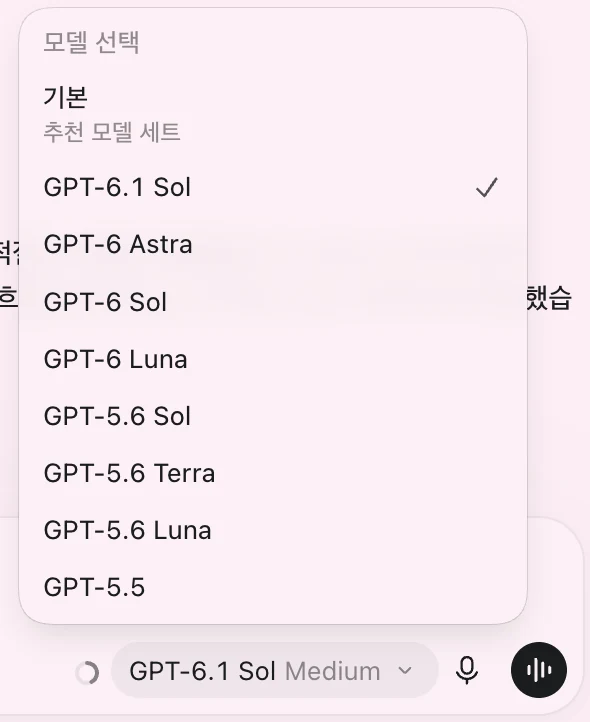
The opening three-app image is an edited illustration. The model picker records the choices visible on my account; it does not show which model answered a request.
What I kept fixed in the October 2 research task
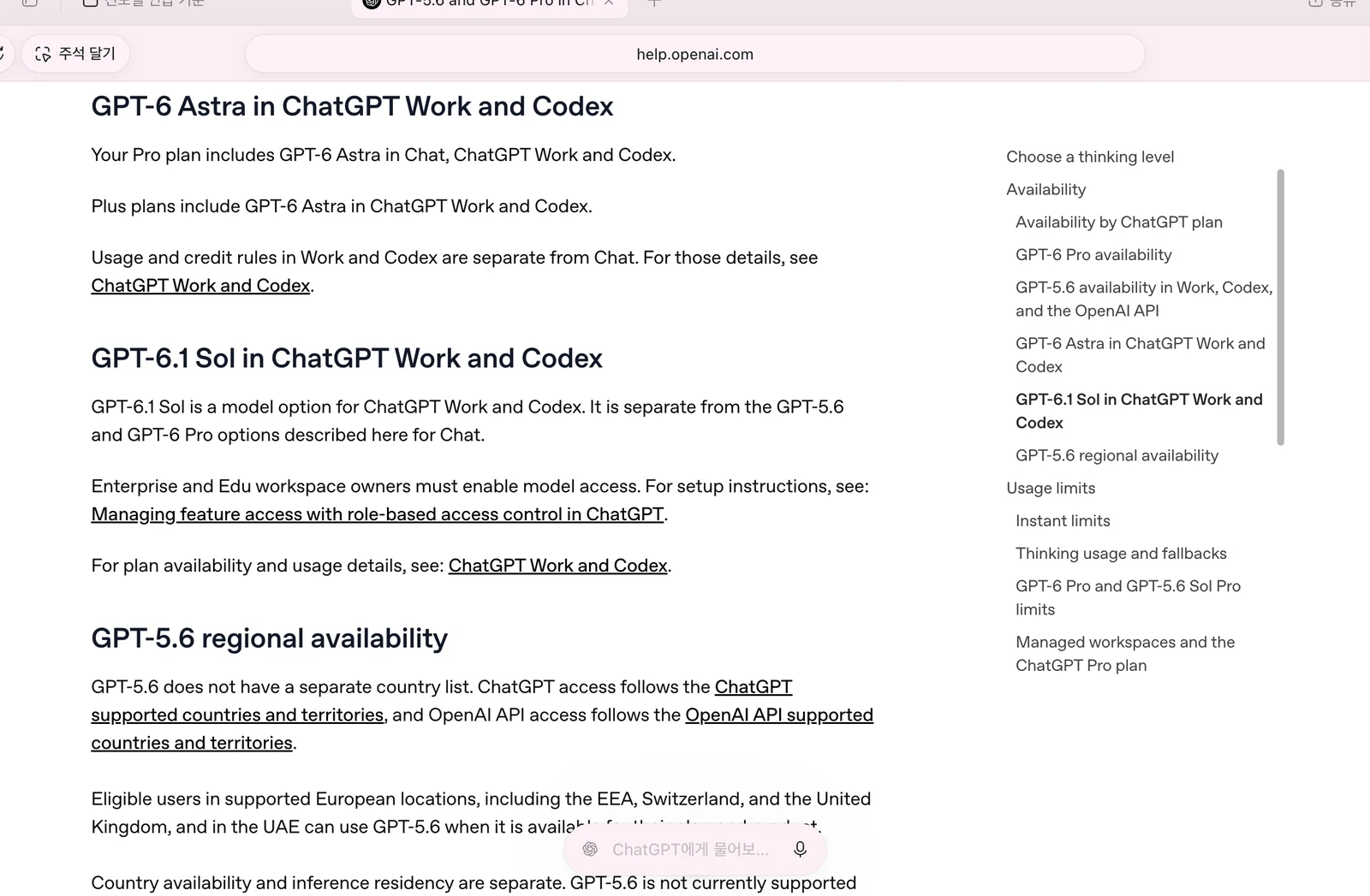
I used ChatGPT Work for this research task. The current Models guide, checked October 31, 2026, lists GPT-6.1 Sol for Work and Codex. Use a model offered by your account for the repeatable exercise below; this historical comparison does not establish current access to the original pair.
The reasoning level sets how much thinking effort the model uses. I kept both models at the same visible Medium setting. Matching that label does not establish equal reasoning across model generations; the October 23 follow-up below checks that distinction.
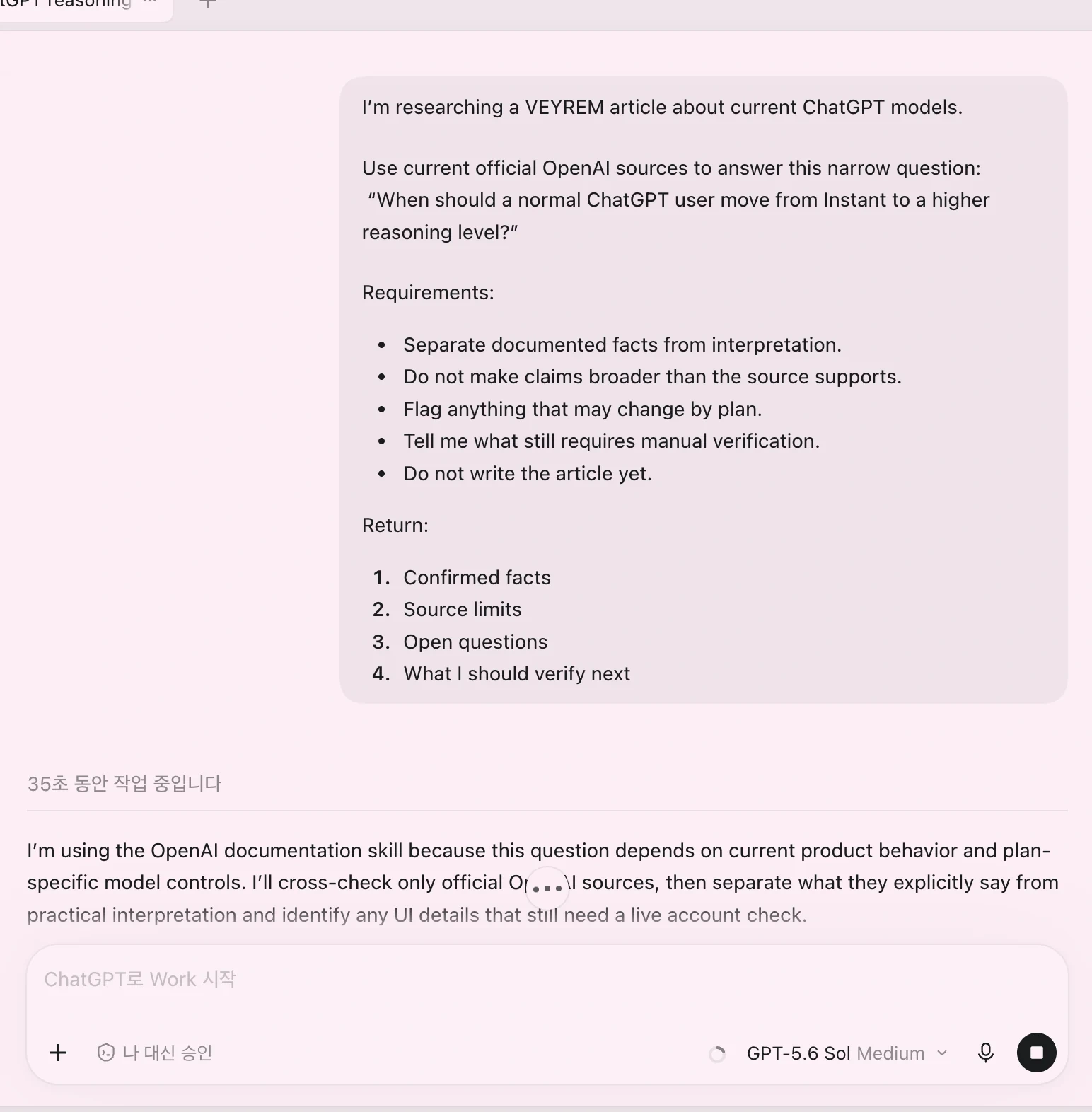
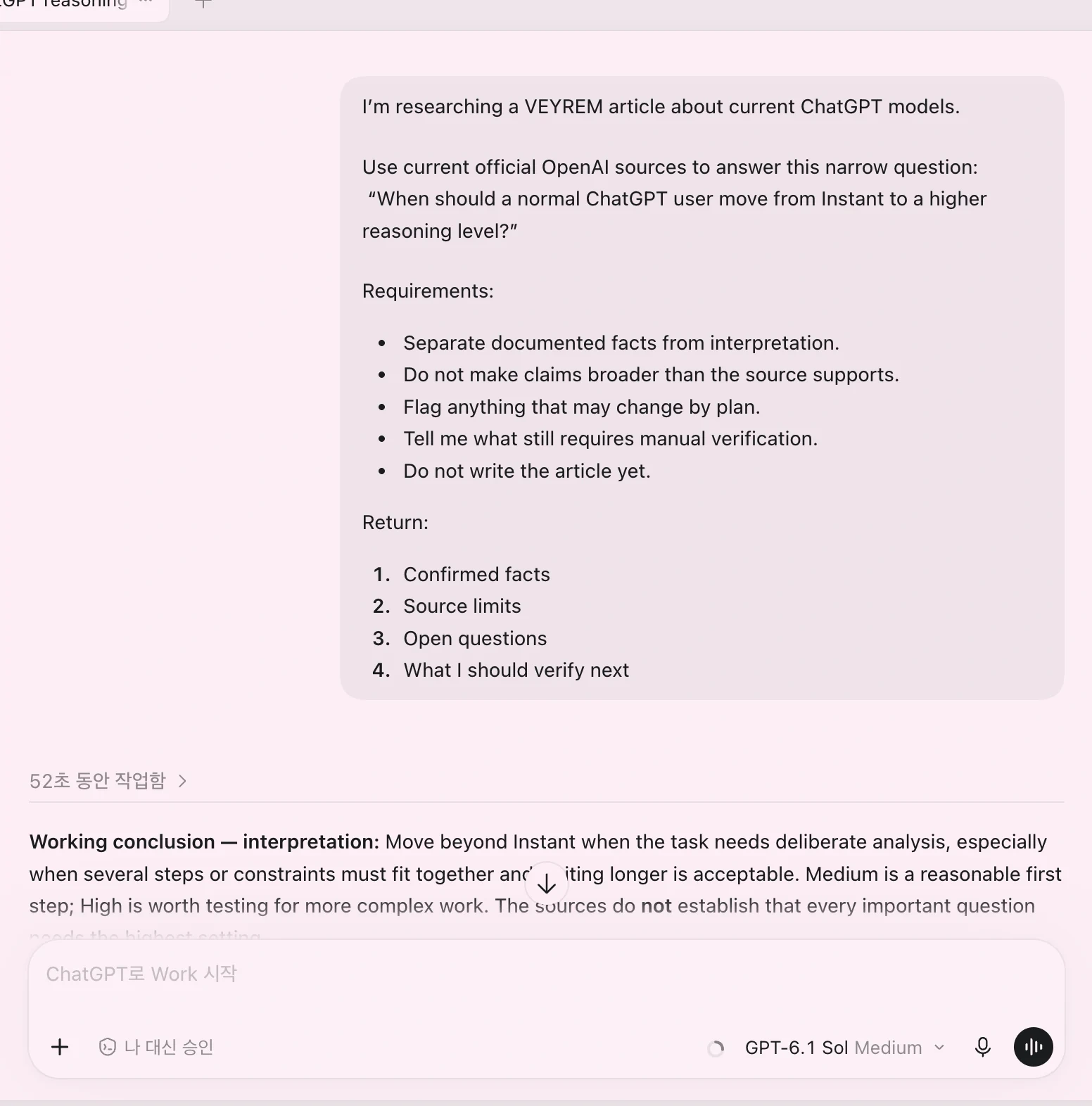
I also kept the prompt—the request typed into the chat—the same. Each model got a fresh Work conversation with the same question and requested answer structure.
GPT-5.6 vs GPT-6.1: the question I sent to both models
The research question was when a ChatGPT user should choose a higher thinking level instead of Instant. Both models researched that question while set to Medium, so this was a comparison of their research answers, not a test of Instant against Medium.
I asked both models to use current official sources, separate facts from advice, and flag any differences between plans. I also asked them to say what still needed checking. I wanted research notes I could verify before writing.
The four sections—confirmed facts, source limits, open questions, and next checks—gave me somewhere to look when I needed to tell an OpenAI rule apart from the model’s own advice.
The same rule, explained two ways
I checked the automatic-switching rule because two details change its meaning: the plan names and the safety exception. Without the exception, “doesn’t switch for a complex request” becomes “never switches.”
Here is how the two answers handled that same rule:
| What I checked | GPT-5.6 Sol Medium | GPT-6.1 Sol Medium |
|---|---|---|
| The automatic-switching rule | “On Plus and Pro, selecting Instant does not automatically move the request to a higher thinking level…” | Under Plus and Pro: “Instant does not automatically increase thinking for complex requests.” |
| Which plans the rule applies to | Names Plus and Pro in the sentence | Names Plus and Pro at the start of the bullet |
| The safety exception | Notes that automatic switching can still happen for safety reasons | States that safety-related switching remains possible |
| Where advice about trying Medium appears | In a separate interpretation section | In a working conclusion labeled as interpretation |
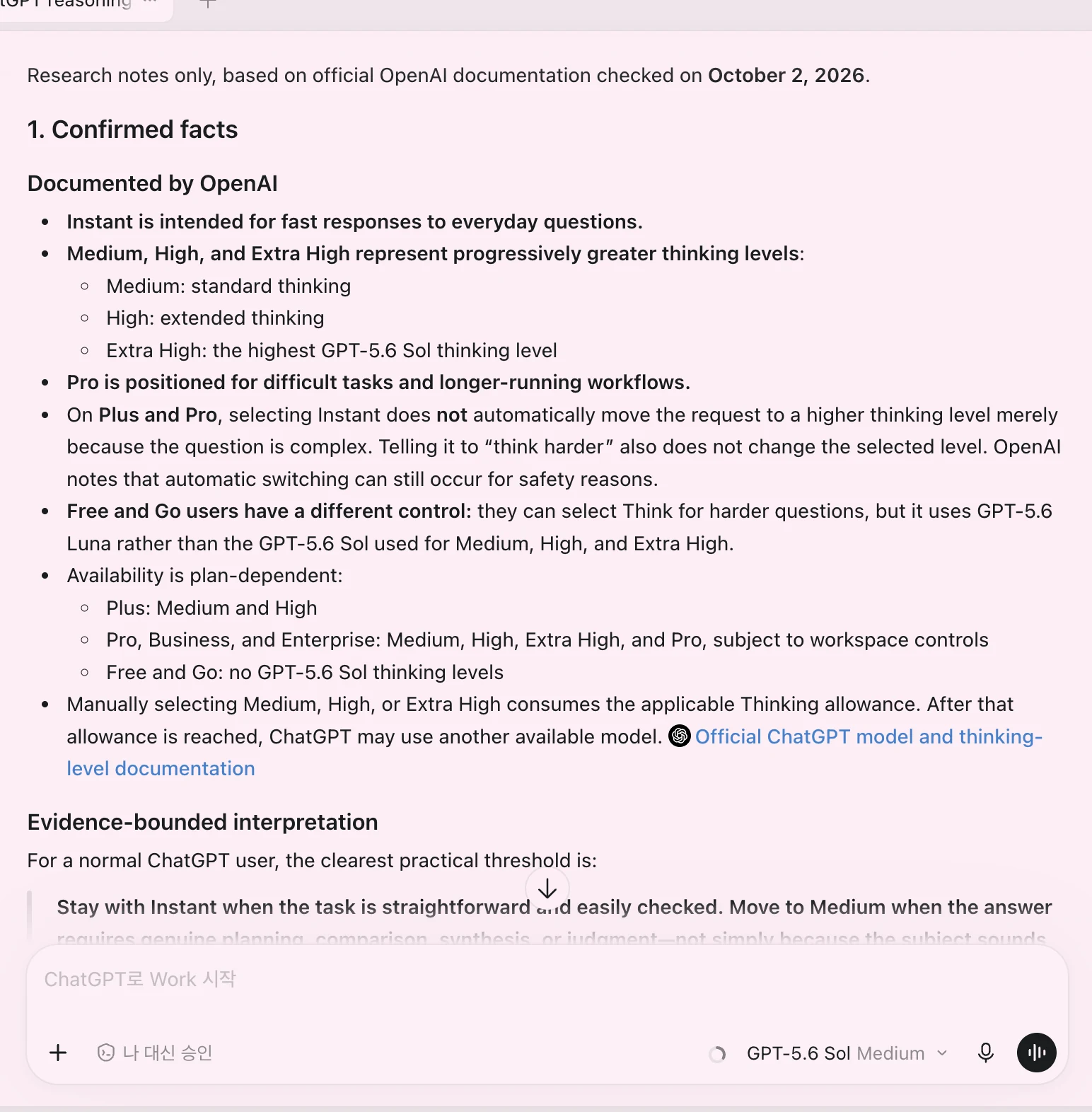
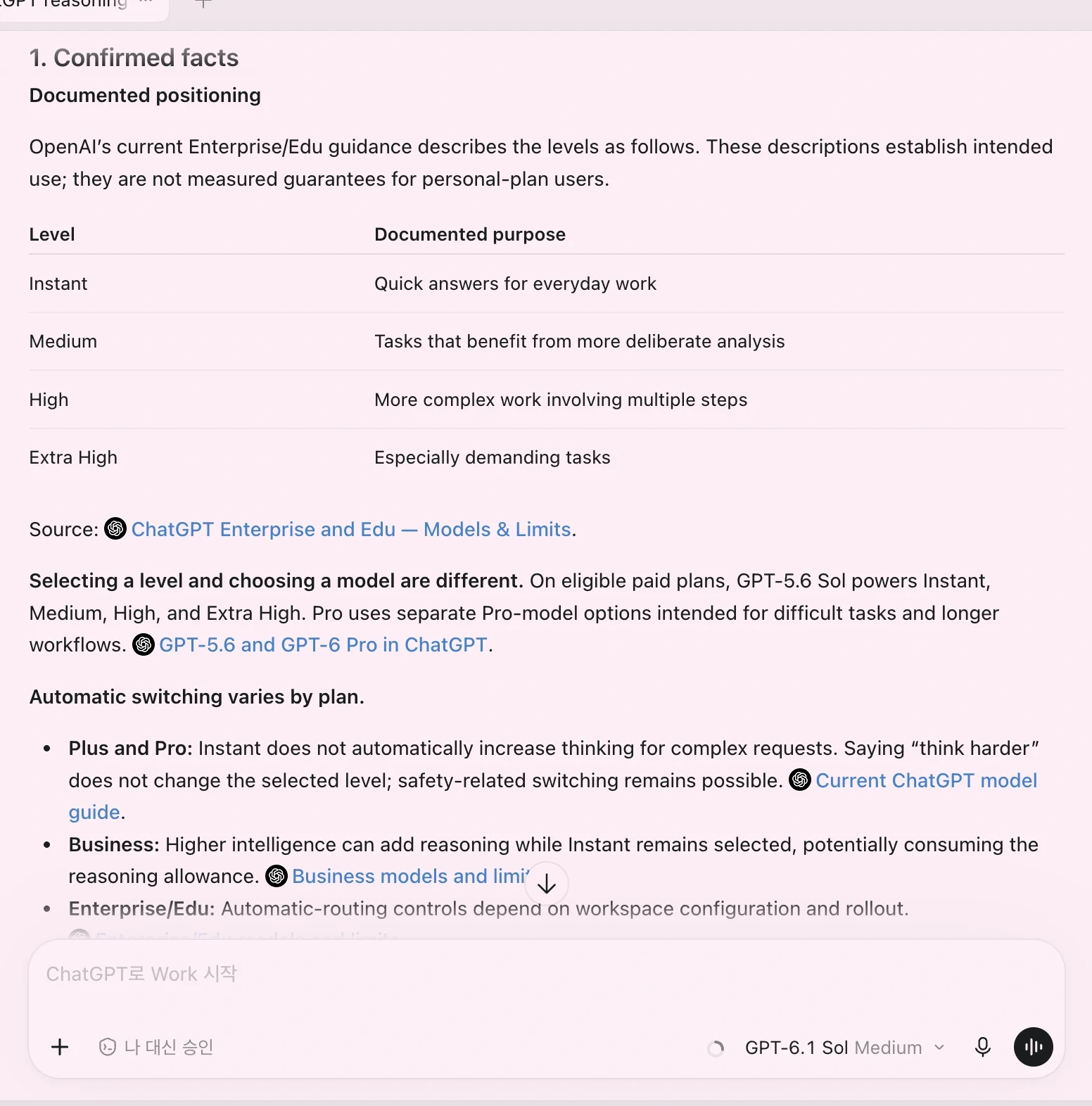
I matched those passages against OpenAI’s guide in the October 14 source check. The recorded rule distinguished a complex question from safety-related switching. Both answers kept that distinction; “Instant never switches” would have lost it. This paragraph records that earlier comparison, not an October 30 check of the Instant policy.
GPT-6.1 also pointed out that its detailed task descriptions came from OpenAI’s guidance for Enterprise and Edu, its workplace and education plans. That explained what the thinking levels were intended for. It didn’t tell me how well they performed on my account.
How I’d check the same rule
Current repeatable path—documentation checked October 31, 2026: Use the self-contained same-source exercise below. Its passage about reasoning efforts still appears in the current Models guide. Start with a model and effort your account actually offers; the old pair is not required to check the two draft sentences. If you compare two available models, keep the supplied passage and visible settings fixed without treating equal labels as equal computation.
Earlier Instant-rule exercise—October 14 documentation check
This earlier request depends on the rule and source passage checked then. It is preserved as historical material, not the required current exercise.
To repeat the October 14 exercise, use the official passage from that date if you saved it, including the Plus and Pro conditions and the safety exception. OpenAI’s current model guide describes the thinking controls but no longer includes that passage. If you don’t have it, use the self-contained exercise below.
Replace the bracketed line after Source paragraph: in the block below with the paragraph you copied. Then send the whole block in a fresh Work conversation at Medium. If your account offers both models, repeat in a separate conversation with the other model. Use the same paragraph, request, and Medium setting so you’re comparing their explanations of the same information.
This is a suggested check, not the prompt used in the original comparison:
Suggested prompt. Paste into a fresh ChatGPT Work conversation at Medium. Copy the full official source paragraph, including the plan names and safety exception. Replace the bracketed source paragraph; use the same input for each model.
Explain the automatic-switching rule using only the source paragraph below. Keep the plan names and the safety exception. For the rule, plan names, and exception, quote the words that support your answer. Put any advice of your own under “My suggestion.”

Source paragraph:
[Paste the full Plus/Pro paragraph here, including the safety exception.]
When the answer comes back, check these three details against the source:
- The automatic-switching rule
- The plans it applies to: Plus and Pro
- The safety exception
The quoted words should support each one. If the exception is missing, a focused follow-up is: “You left out the safety exception. Add it and show the changed sentence.” Compare the corrected sentence with the source before using it.
Documentation rechecked October 14, 2026. The screenshots preserve the October 2 comparison. If only one model is available in your account, you can still use the paragraph check with that model.
October 23 follow-up: the same source, prompt, and checks
The original research comparison left source retrieval uncontrolled. For this follow-up, GPT-5.6 Sol and GPT-6.1 Sol each received the same pasted passage in a fresh ChatGPT Work conversation, once per model, at Medium with Fast mode off. No project or files were attached. The request asked for an English answer under 180 words without browsing or tools; neither conversation showed tool activity.
The passage came from OpenAI’s Models guide, checked October 23, 2026. Its two supplied sentences were still present when I reviewed the guide on October 31. That documentation review does not change the date or conditions of the recorded model runs.
Before sending either request, four checks were fixed: reject the claim of equal reasoning across generations; keep the lower-setting recommendation and adjustment step; quote the supplied text accurately; and leave speed, token use, and research performance unverified.
Exact input sent to both models
Use only the source passage below to check this two-sentence draft. Do not browse, call tools, use plugins, create files, or use outside knowledge. Reply in English.

Draft:
1. Selecting Medium gives the same amount of reasoning across model generations.
2. Therefore, always start with the highest reasoning setting.

For each sentence, give a verdict (Supported, Contradicted, or Not established), a one-sentence correction, and an exact short quote from the source that supports your correction. Then answer: Does this passage establish which model will be faster, use fewer tokens, or perform better on my research task? If not, say what remains unknown. Keep the answer under 180 words.

Source passage:
Reasoning efforts don’t map exactly between model generations. Try a familiar task at a lower setting and adjust based on the result.
Both answers met those four checks in this one task. Neither needed a follow-up correction. The table summarizes the answers rather than scoring the models’ overall accuracy.
| Check fixed before the runs | Observed in both answers |
|---|---|
| Reject equal reasoning across generations | Both marked sentence 1 contradicted and rejected the claim that the same setting establishes equal reasoning. |
| Correct the highest-setting instruction | Both marked sentence 2 contradicted and retained a familiar task, a lower setting, and adjustment based on the result. |
| Quote the supplied evidence accurately | Both quoted each source sentence exactly for its corresponding correction. |
| Keep unsupported comparisons unknown | Both left comparative speed, token use, and research performance unknown. |
Neither task measured latency, cost, or token use. Account instructions, hidden system instructions, backend versions, and network conditions were not controlled. The same Medium label does not establish identical computation. The follow-up supports using either explanation for this passage after checking it; it does not establish a general research winner.
Evidence and check dates
- Tool: ChatGPT Work web; independent conversations for the October 23 follow-up.
- Model: GPT-5.6 Sol and GPT-6.1 Sol; Medium, Fast off; one run per model.
- Dates: Original research comparison: October 2. Same-source follow-up: October 23, 2026. Models guidance and the repeatable passage rechecked October 30 and October 31; neither comparison was rerun.
- Input: The same pasted official passage and two-sentence draft; four evaluation criteria fixed before either follow-up run.
- What was checked: Direct follow-up: both replies met all four source-faithfulness criteria. Original research retrieval was not controlled.
- Not checked: No general winner, latency, cost, token-use, or identical-compute result. Hidden instructions and backend state were not controlled.
Source status: Rechecked October 31, 2026: Models for Work/Codex model controls and the passage stating that reasoning efforts do not map exactly between generations. Available choices vary by account and workspace. The Instant/Plus/Pro rule remains the earlier October 14 source check. No new model, timing, price, or accuracy comparison was made.
Official sources
- OpenAI — Models: reasoning-effort passage and GPT-6.1 Sol Work/Codex listing reviewed October 31, 2026.
What this comparison can’t tell us
The account’s controls showed the model and reasoning level separately.
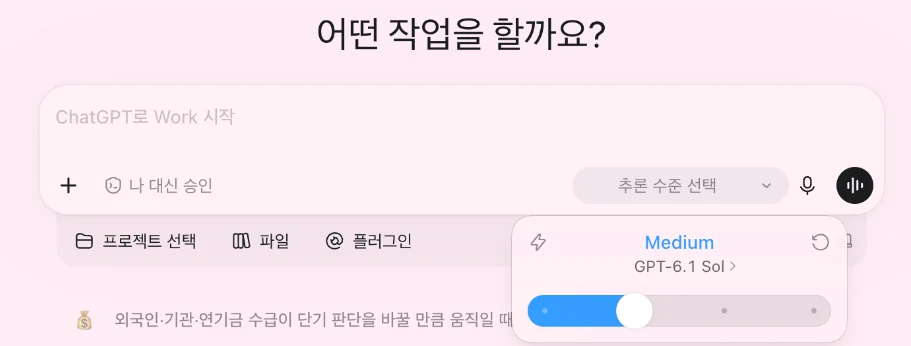
The control screenshot records a visible selection. It cannot establish an equal compute budget or reveal the hidden instructions and backend state described in the task limits above.
What I’d choose after this comparison
For the rule I checked, I could use either model’s explanation after comparing it with the source. The formatting difference alone wouldn’t make me switch.
For your own task, compare what each answer keeps from the source: the rule, who it applies to, and any exception. An answer that drops one of those needs fixing, however polished it looks. If both preserve them, choose the format you find easier to check and use.