
I wanted ChatGPT to help me get a VEYREM article from an idea to something ready for WordPress. After the first six articles, I kept running into the same problem: I had a draft before I’d worked out what I could say from my notes.
I still had to decide which claims to keep, only now that decision came with paragraphs to rewrite. The example below follows one article from that period; it is not a review of all six.
Before asking for paragraphs, point to the material behind the main claim. A missing example is easier to resolve before it has a section built around it.
On this page
The setup that helped
I kept the topics and their current stages on a content board, so I could see which ideas were still waiting and which drafts were underway.
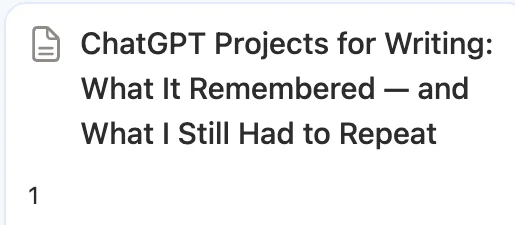
The cropped card shows the Projects article title on my content board. It records topic organization, not the edits or time saved. With the ideas in one place, I could ask ChatGPT which question an article might answer and how to organize it. The examples still had to come from the work behind each article.
Where my AI-assisted writing workflow needed rework
The trouble began when I asked for finished paragraphs too early.
In the second VEYREM article, the title promised real lines I’d cut from a draft. At one point, I had only one strong example ready and a table placeholder.
What I had to go back and do
- Return to the source draft. I went back to the first article and checked the removed lines against its final version.
- Add the missing examples. I added those documented edits to the second article, giving its plural title more than one example.
- Remove the unfinished table references. I removed references to the table placeholder instead of leaving that part of the draft unresolved.
The finished edit record shows the individual wording changes. Here, the rework was returning to the source draft to find and check examples after the article already had prose. Polishing that prose would not supply the missing material.
I didn’t time the process, so I can’t say how much longer it took. What I can describe is the editing I had to do.
That left me with a smaller job to give ChatGPT before another draft: match the question to the notes, then name the missing piece.
To check your own notes before drafting, paste this into ChatGPT. Replace the bracketed line with your notes and any source passages you have.
Read my article notes below. Before writing a draft, tell me:
1. The main claim the notes support.
2. The specific note or source behind that claim.
3. Any missing material I need to supply.

If the notes do not support the claim, suggest a narrower one. Do not invent experiences, evidence, or results. Stop after this check.

Notes: [paste your article notes and any source passages]
Before asking for another draft
If you already have a draft, mark the sections that depend on missing material. For each one, decide whether to find the supporting observation or source passage, narrow the claim, or leave it out. Then reread the surrounding paragraphs so they fit that choice.
In the draft above, the missing material was specific: more documented edits for a title that promised several. Another outline would not supply those edits.
Where the extra work came from
My AI-assisted writing workflow needed rework because I asked for paragraphs before deciding what my notes supported. Claims I’d left unsettled during planning became paragraphs I had to rewrite during review.
For your next article, write down the main claim, the material behind it, and any missing detail. If those are difficult to identify, use the five-part writing brief before drafting.
Evidence and check dates
- Tool: ChatGPT-assisted drafting, a Notion content board, and editorial review.
- Model: Not recorded.
- Dates: Original workflow dates not recorded. Record reviewed October 23, 2026. Editorial scope and recovery steps clarified October 28, 2026; no new model test.
- Input: A content-board record and the second article’s missing edit examples, from the first six VEYREM articles. This account does not document a separate review of each of the six.
- What was checked: The recorded recovery steps for the second article: checking removed lines against the first article’s final version, adding documented examples, and removing unfinished table references. The advice for another draft is a suggested next step.
- Not checked: No timing log, controlled automation comparison, or measured productivity gain.
Source status: Source: the content-board record and documented VEYREM draft edits described above. No product price or measured efficiency result is claimed.