
This is why ChatGPT writing sounds robotic in many drafts: it keeps finishing the same thought for you.
I do not think the biggest problem with ChatGPT writing is that it uses big words.
The bigger problem is that it keeps trying to finish the thought for you.
You write one useful point. Then it gives you the point again as a cleaner conclusion, then one more version in case you missed it. Nothing is technically wrong. It just starts to sound like the same idea explained from three angles.
I noticed this while marking up the first VEYREM draft about ChatGPT Projects. I am using that article here only because it was the first real VEYREM draft I had to edit—not because this problem belongs only to ChatGPT Projects.
The draft had real material in it, but a few lines still sounded like a well-behaved tech guide instead of someone who had actually done the work.
So before fixing grammar, I cut or rewrote any sentence that a competent AI blogger could drop into almost any article.
This is one edit pass on one real draft, not a scientific test. But it gave me a more useful test than a blacklist of banned words.
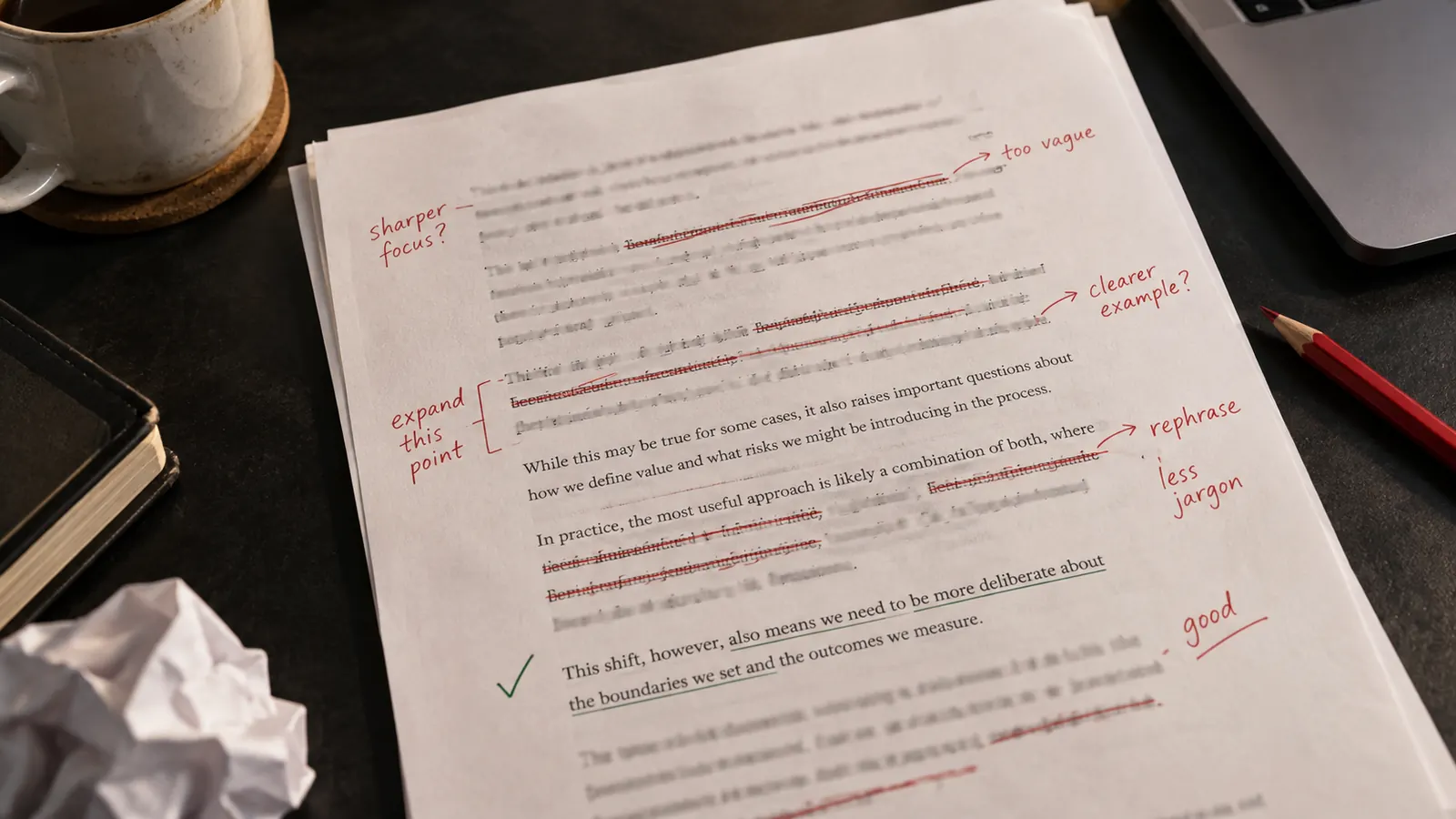
Table of Contents
Why ChatGPT Writing Sounds Robotic in Real Drafts
These three edits solve different problems: polished filler, hidden work, and repeated conclusions.
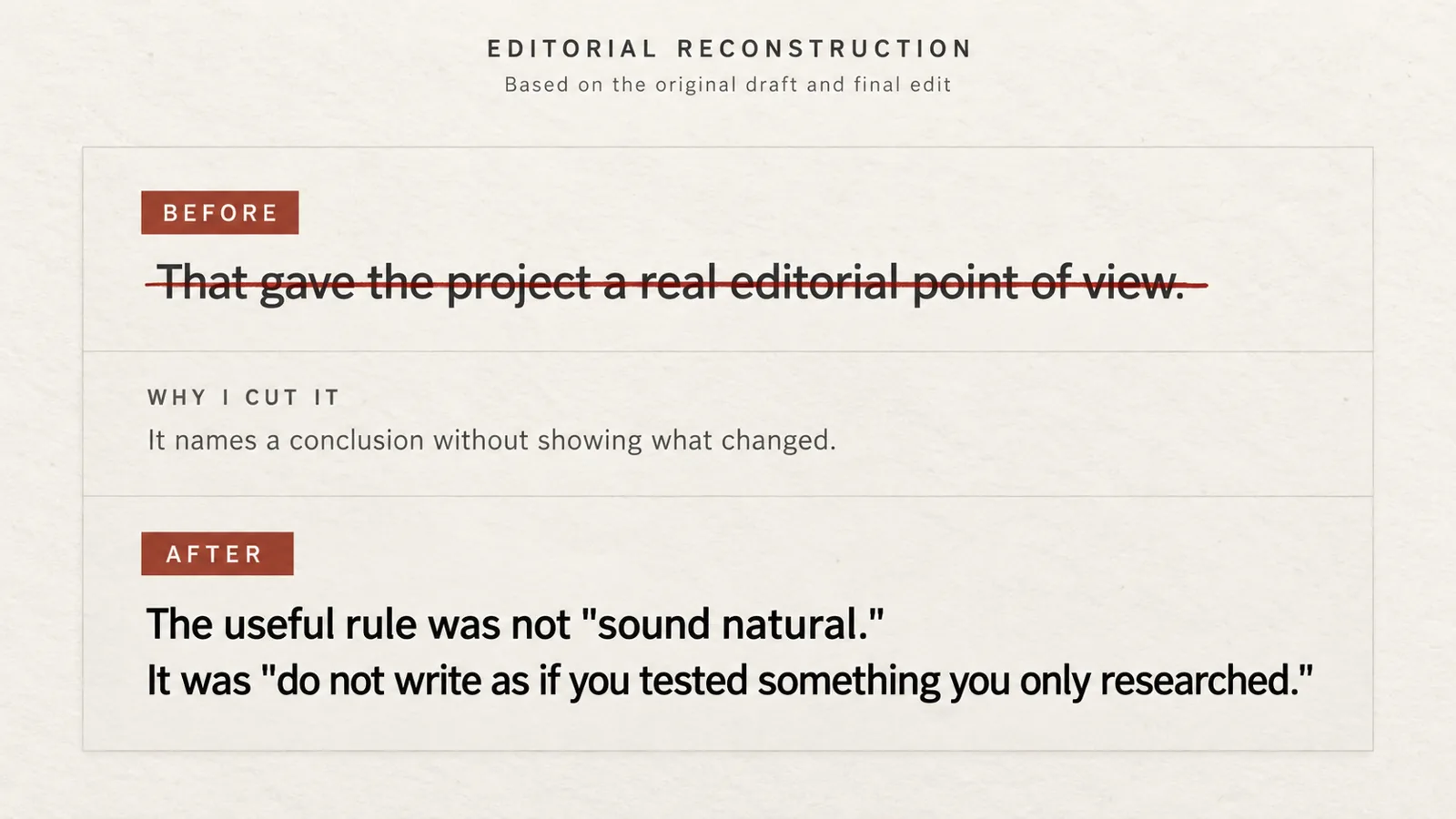
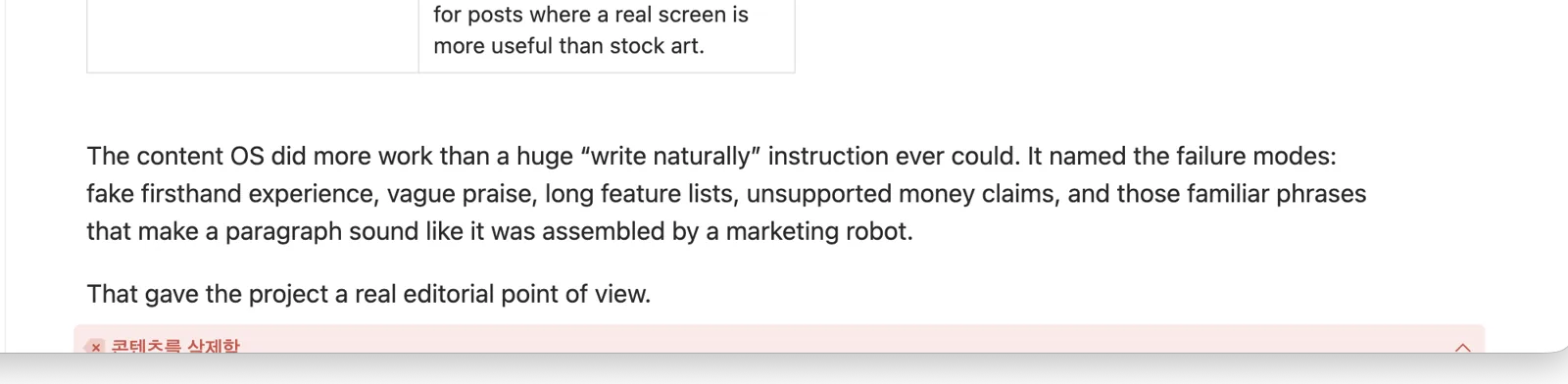
The first image is an editorial reconstruction. The cropped version-history view after it shows the earlier draft before the first line was cut.
1. A polished summary that did no work
Original
“That gave the project a real editorial point of view.”
Why I cut it
It was not false. It was just too abstract. The sentence did not say which rule mattered or what that rule stopped me from doing.
What I used instead
“The useful rule was not ‘sound natural.’ It was ‘do not write as if you tested something you only researched.’ That stopped the draft from borrowing a fake first-person story.”
The second version is less polished. Good. It has something at stake.
2. A neat sentence that hid the work
Original
“The live sources and human review still owned questions one and two.”
Why I cut it
This sentence compressed two real jobs into one vague line. I still had to check current product claims myself, then decide which first-person statements the work could actually support.
What I used instead
“I still had two jobs the Project could not do for me: verify current claims against official sources, and decide which parts of the article I had actually tested myself.”
That version is longer, but now the reader can see the work instead of being told that “human review” happened.
3. A conclusion that was too easy to repeat
Original
“Projects reduce repetition. They do not remove ambiguity.”
Why I cut it
The idea was right. It was also easy to write, and the draft had begun saying the same thing in several variations.
What I used instead
“A Project can remember the house rules. It cannot know what you actually tested unless you tell it.”
Then I stopped explaining the point and showed it in the workflow result.
I make this edit a lot: delete the extra conclusion and use the space for evidence.
What the draft could actually claim
ChatGPT writing sounds robotic when the claim is cleaner than the evidence behind it.
A title that says “I tested this” needs a visible boundary around the test. For the Projects article, two rows mattered most:
| What the draft could claim | What the work actually showed |
|---|---|
| The Project carried the site rules into a fresh chat. | Mostly yes. It preserved enough audience, voice, and publishing context to start the task. |
| The Project knew what I had personally tested. | No. I still had to state that boundary explicitly. |
That boundary matters more than another polished summary of the result.
The edit pass I actually keep
ChatGPT writing sounds robotic when repeated conclusions survive the edit, so I run one quick pass in this order:
- Underline every sentence that sounds like a conclusion.
If two lines make the same point, keep one. - Write the evidence beside each remaining claim.
What did you actually do, see, compare, or verify? - Check every first-person sentence.
If “I” does not point to an action, observation, or decision, it may just be decoration. - Lower the confidence or cut the sentence when the evidence is weak.
A clean sentence is not a substitute for support. - Ask whether someone who never did the work could have written the paragraph.
If yes, cut it, shorten it, or add the detail they could not know.
The last question is the one I trust most.
A quick note on Google
This edit is not about trying to disguise AI-written prose for search engines. Google’s current guidance still centers on useful, reliable, people-first content and original value; its guidance for generative AI search applies the same fundamentals rather than a separate “AI writing” trick. Google Search Central: Creating helpful, reliable, people-first content Google Search Central: Guide to optimizing for generative AI features
The practical test is simpler: does the page contain something that only exists because a person actually did the work?
The line I ask before publishing
“Could a person who never did this work have written this paragraph?”
If the answer is yes for most of the article, I keep editing.
ChatGPT writing sounds robotic when I keep its cleanest conclusions without adding my own evidence. It can still get me to a clean draft quickly. Deciding what actually belongs to me is the part I am not handing over.