
I started to see why ChatGPT writing sounds robotic while editing the first VEYREM article: I kept finding sentences that said the same thing twice.
One useful point would be followed by a neat conclusion, then another version of that conclusion. The grammar was fine, but the paragraph stopped moving.
The draft was about ChatGPT Projects, a place to keep related chats, files, and writing instructions together. Some sentences could have appeared in almost any AI blog post, so I edited those before worrying about grammar.
Here are three lines from that draft, along with a prompt you can use to check your own writing.
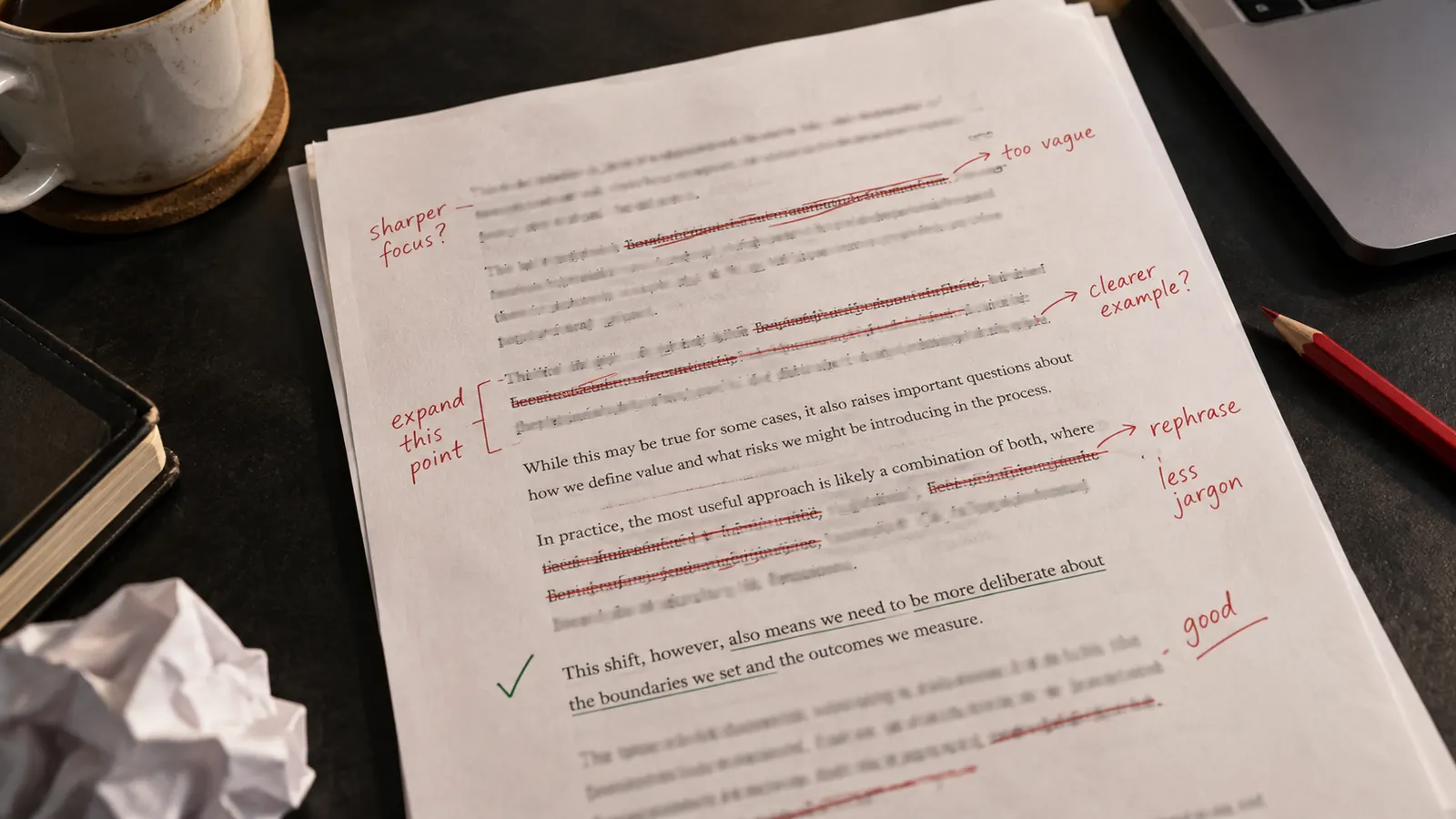
Editorial illustration of draft editing; this cover is not an original edit screenshot.
On this page
Three lines I changed
The first image below recreates the edits. The version-history image after it shows the earlier draft before the first line was removed.
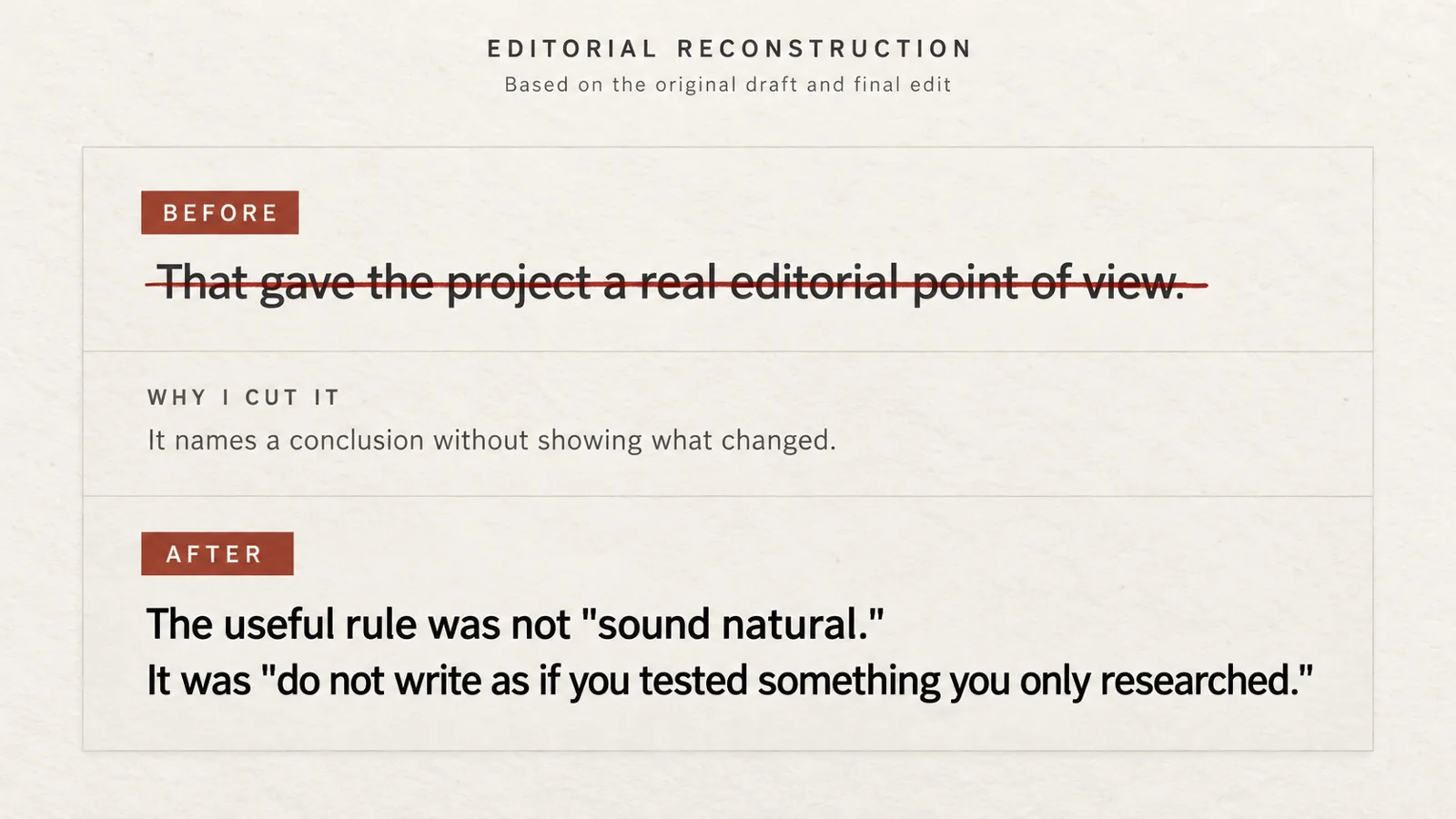
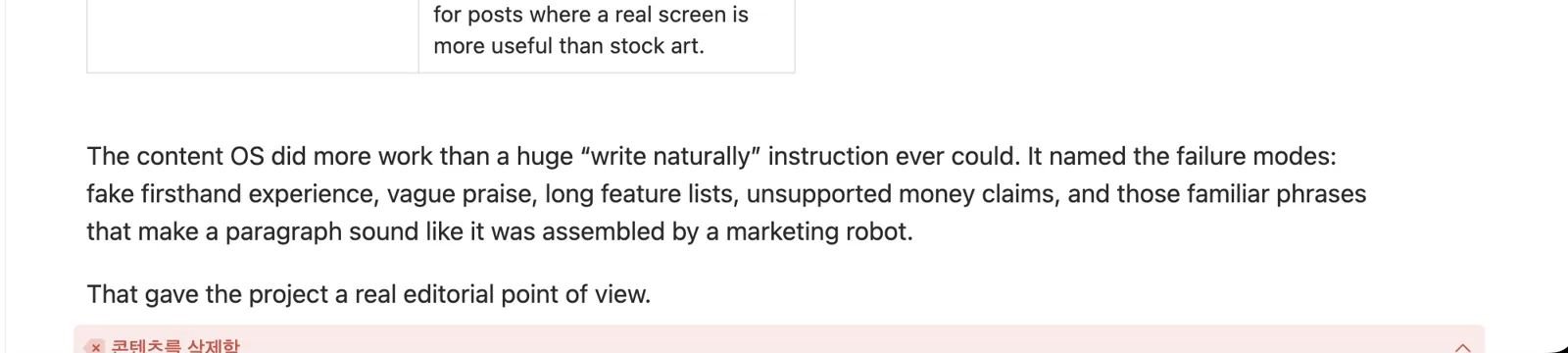
The comparison is an editorial reconstruction of a documented wording edit. The version-history screenshot shows the earlier draft; it was not captured during a new test.
Reading the examples: Original and Earlier revision preserve the recorded wording. What I would keep now marks a suggested edit or deletion, not a new chat result.
“A real editorial point of view”
Original
“That gave the project a real editorial point of view.”
It didn’t tell the reader which rule helped or what changed in the draft.
Earlier revision
“The useful rule was not ‘sound natural.’ It was ‘do not write as if you tested something you only researched.’ That stopped the draft from borrowing a fake first-person story.”
What I would keep now
The rule was: “Do not write as if you tested something you only researched.”
This keeps the recorded instruction. The earlier claim about what it prevented would need a specific draft change to support it.
With a phrase like “a strong foundation” or “a better workflow,” the next question is: which step got easier, or which problem did it help prevent? That answer gives the reader something useful. If your notes don’t show a change, the praise can go.
“Human review” without saying what I checked
Original
“The live sources and human review still owned questions one and two.”
I knew what I meant. A reader had to work it out.
Earlier revision
“I still had two jobs the Project could not do for me: verify current claims against official sources, and decide which parts of the article I had actually tested myself.”
Here, “verify current claims” means opening the latest product help page and comparing it with the sentence in the draft. ChatGPT can help find and compare sources; this earlier wording describes the checks I still did myself.
“Review the output” leaves the reader with the same problem. What are they looking for? You can tell them to compare a number with the original table, a claim with the source passage, or the answer’s steps with the ones they requested.
One more conclusion the paragraph didn’t need
Original
“Projects reduce repetition. They do not remove ambiguity.”
The draft had already explained that Projects reduced setup work while some details still needed repeating.
Earlier revision
“A Project can remember the house rules. It cannot know what you actually tested unless you tell it.”
That sentence still sounded like a rule about every Project.
What I would keep now
The new chat used the audience, tone, and structure I’d saved for the article. I still had to tell it what I’d actually tested. Those two observations were enough, so I dropped the summary line.
Try this on one paragraph
Start with the review request below in a ChatGPT chat. Replace [PASTE YOUR PARAGRAPH], including the brackets, with one paragraph from your draft. Apply one small edit and compare it with the original; use the later follow-up only if that edit loses a detail you need to keep.
If you don’t have a draft handy, try this made-up example.
I checked the dates against the original email. I went back to the email to make sure the dates were right.Suggested prompt. Paste into the ChatGPT message box. Have one paragraph from your draft ready. Replace [PASTE YOUR PARAGRAPH].
Review this paragraph. Do not rewrite the whole paragraph.
Find repeated conclusions, vague phrases, or instructions that leave the reader unsure what to do.

For each clear issue:
- Quote the exact sentence.
- For repetition, also quote the earlier sentence that makes the same point. Keep sentences that add a new reason, example, or limitation.
- For vague wording or instructions, explain what the reader still needs to know.
- Suggest the smallest edit: quote the sentence to remove, or give a replacement sentence using only the information supplied. If a needed detail is missing, ask a specific question instead of inventing it.

Keep the supplied observations, numbers, and limits. Do not add an anecdote, result, or personal experience.
This is a wording review. Do not mark facts as verified without checking their sources.
If you find no clear issue, say so. Do not force a rewrite.

PARAGRAPH: [PASTE YOUR PARAGRAPH]
A useful answer quotes the problem sentence, explains the issue, and gives a small edit or a question you can answer. “Make it more natural” on its own doesn’t tell you what to change.
If ChatGPT marks two sentences as repetitive, read them together. Does the second add an example, a reason, or a limit? If it does, keep that detail. Otherwise, try removing it and check that the next sentence still makes sense.
If ChatGPT asks for more information, answer from your notes and ask it to suggest a replacement for that sentence only. If you don’t have the answer, leave that part out or say what you haven’t checked. Apply one suggested edit to a copy of your paragraph before using the checks below.
An edit can also cut something you wanted to keep. If that happens, send the prompt below in the same chat. Replace the three bracketed fields with your original paragraph, the sentence you want changed, and the detail that must stay:
Suggested prompt — follow-up. Paste into the same ChatGPT chat. Have the original paragraph, target sentence, and detail to keep ready. Replace all three bracketed fields.
Make one edit to the original paragraph below.
Change or remove only the target sentence to fix the issue we identified. Keep the other sentences unchanged, including the detail I name.
Do not add new facts, experiences, or results. If one sentence cannot be changed without losing necessary meaning, explain why and stop.
Return the revised paragraph and one sentence explaining the change.

ORIGINAL PARAGRAPH: [PASTE YOUR ORIGINAL PARAGRAPH]
TARGET SENTENCE: [PASTE THE EXACT SENTENCE TO CHANGE]
DETAIL TO KEEP: [PASTE THE DETAIL]
What to check before keeping the edit
In this draft, repeated conclusions and vague phrases made the writing feel robotic. Start by removing a sentence that repeats a point or replacing vague praise with the specific check your notes support.
Read the two versions side by side. Check the names, numbers, and small phrases that set a limit, such as “in this draft” or “in my test.” If the edit loses a detail your reader needs, go back to the original and change just the sentence that bothered you.
Evidence and check dates
- Tool: A ChatGPT-assisted VEYREM draft and its version history.
- Model: Not recorded.
- Dates: Original editing date not recorded. Record reviewed October 23, 2026. Current keep-or-delete recommendations added October 28, 2026; no new prompt run.
- Input: Three documented lines from the Projects draft, with earlier revisions.
- What was checked: Three recorded edits remain verbatim. Current recommendations separate a supported instruction from a prevention claim and remove an extra conclusion. The recommendations and copyable prompts are later editorial suggestions.
- Not checked: No new prompt run, reader study, or general AI-writing detection test.
Source status: Source: the documented Projects-article edits and version-history image above. This is an editorial case, so a product feature or price comparison does not apply.