
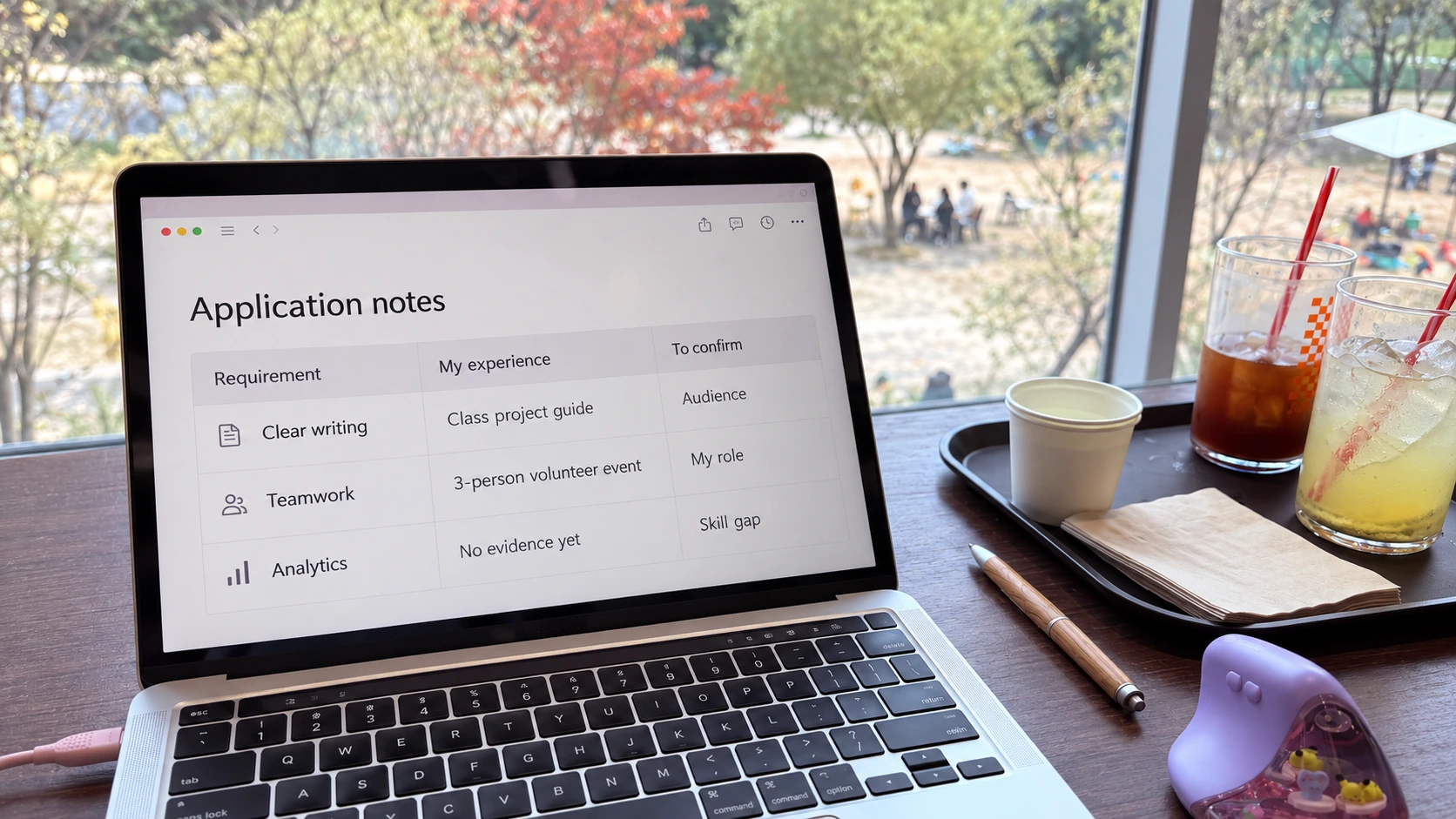
A job description tells you what an employer is looking for. Your notes tell you what you have actually done. Put the two side by side before you write a resume bullet or cover letter. A resume bullet is a short line about something you did.
ChatGPT can help organize the match, but it should not fill a gap with an invented project, skill, number, or result. The useful output is an evidence table: each requirement, the experience that supports it, and anything you still cannot prove.
Gather the job description and your experience notes
- The job description: copy the responsibilities and qualifications that matter for the role.
- Your experience notes: list real work, school projects, volunteer work, personal projects, tools, and outcomes you can explain if asked.
Remove names, phone numbers, addresses, employee IDs, confidential project details, and anything your employer does not allow you to share. If you prefer, replace organizations with neutral labels such as Company A or Class Project.
ChatGPT can work with pasted text and supported document uploads. Availability and limits can vary by plan and workspace. For a first attempt, pasting only the relevant sections is usually simpler than uploading a full resume. [1]
Start with your experience notes
Do not start with polished resume language. Use plain facts:
- Wrote step-by-step instructions for a class project.
- Organized shared files and kept a weekly task list.
- Coordinated a three-person volunteer event.
- Used documents, spreadsheets, and presentation tools.
- Found and corrected errors in my own reports.
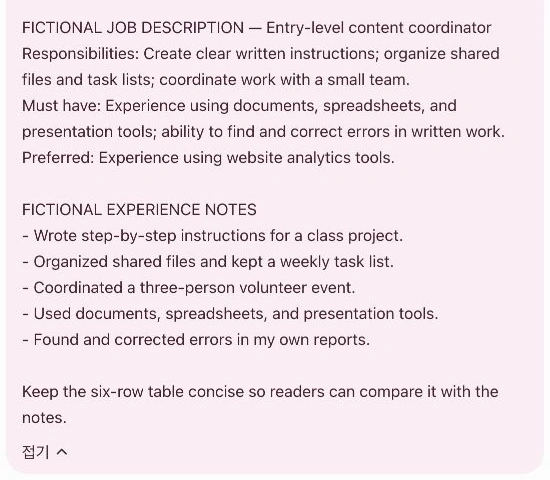
These notes are fictional. To try the example before using your own material, pair them with this fictional posting:
FICTIONAL JOB DESCRIPTION — Entry-level content coordinator
Responsibilities: Create clear written instructions; organize shared files and task lists; coordinate work with a small team.
Must have: Experience using documents, spreadsheets, and presentation tools; ability to find and correct errors in written work.
Preferred: Experience using website analytics tools.
For your own application, replace both the posting and the notes. Include results you can confirm; leave unknown results out.
Paste this request
- Open ChatGPT, sign in if needed, and start a new chat.
- Copy the whole prompt below into the message box. Replace the bracketed items with the relevant job requirements and your factual experience notes.
- Select Send and wait for the table.
The screenshots show a separate recorded demonstration with the fictional materials above.
Match this job description to my real experience.
Write the entire response in English, including headings, labels, and notes.

First, extract the important requirements. Label each one:
- Must have
- Preferred
- Responsibility

Then create a table with these columns:
1. Job requirement
2. Evidence from my notes
3. Match strength: Strong, Partial, or No evidence
4. Exact detail I should confirm
5. Honest gap or next step

Rules:
- Use only the experience notes I provide.
- Do not invent skills, projects, employers, dates, numbers, or results.
- Do not treat a similar experience as an exact match.
- Quote the job description briefly when useful.
- If there is no evidence, write “No evidence provided.”
- Keep my wording factual and specific.

JOB DESCRIPTION:
[relevant requirements from your job posting]

MY EXPERIENCE NOTES:
[your factual experience notes]
What the first table can look like
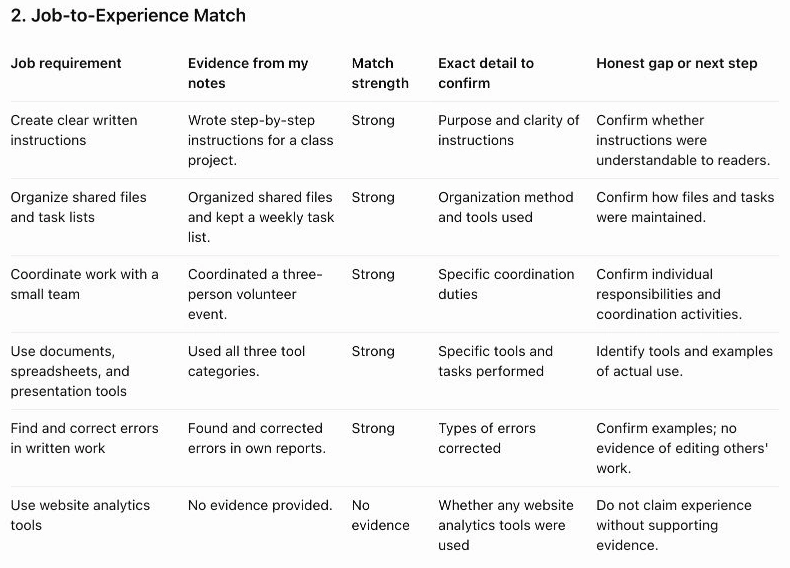
Here is an illustrative table for the fictional posting and notes above. It is an editorial example, not a transcript of the ChatGPT response shown below:
| Job requirement | Evidence from my notes | Match strength | Detail to confirm | Gap or next step |
|---|---|---|---|---|
| Create clear written instructions | Wrote step-by-step instructions for a class project | Partial | Audience, format, and number of guides | Confirm whether the writing was published or graded |
| Organize shared files and task lists | Organized shared files and kept a weekly task list | Partial | Folder structure and tool used | Add one concrete example |
| Coordinate work with a small team | Coordinated a three-person volunteer event | Strong | Your role and the event outcome | Confirm dates and responsibilities |
| Use documents, spreadsheets, and presentation tools | Used documents, spreadsheets, and presentation tools | Partial | Exact products and level of use | Name only tools you can demonstrate |
| Find and correct errors in written work | Found and corrected errors in my own reports | Partial | Type of error and how it was found | Add a verified result if available |
| Use website analytics tools | No evidence provided | No evidence | Whether any relevant tool was used | Leave the skill out unless you can supply a real example |
Read across each row: does the experience actually support that requirement, and what detail is still missing? In the demonstration below, ChatGPT marked five rows Strong even though specific tools and duties still needed confirmation.
Turn one strong match into a bullet
Choose one requirement supported by your notes and put it in the brackets below. Send the request in the same chat; ChatGPT can use the table already there.
Turn the row for this job requirement into two resume bullet options:
[job requirement you want to use from the table]

Use only the facts in that row and my experience notes. Start with my action.
Include a context or tool only if I supplied it, and a result only if confirmed.
Keep each option under 25 words. Do not add new duties, numbers, or outcomes.
Keep numbers tied to exactly what my notes describe. If a detail is ambiguous,
leave it unchanged and flag it for confirmation.
After the bullets, list the facts I should verify before using them.
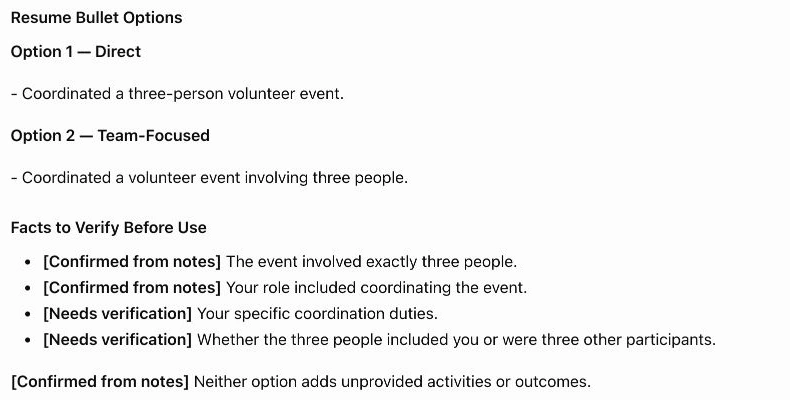
For the fictional volunteer example, the follow-up demonstration produced:
- Coordinated a three-person volunteer event.
- Coordinated a volunteer event involving three people.
Neither option adds duties or results beyond the original note. The screenshot also asks whether the three people included the applicant—a detail to confirm before using either sentence.
Find the gaps before writing the cover letter
Ask ChatGPT:
Using the job description and table already in this chat, show me up to three
important requirements with missing or incomplete evidence.

For each one, ask one factual question to help me find relevant experience.
If no gap is apparent, say so instead of inventing one. If evidence is still
missing, suggest an honest next step without claiming I already have the skill.
A gap question might point you to a class assignment, volunteer task, or personal project you forgot to list. It should not turn a future plan into past experience.
Check every line against your records
Before using the table or bullets:
- Can you explain the example in an interview?
- Can you confirm the tool, date, team size, and result?
- Does the wording match the level of responsibility you actually had?
- Did ChatGPT combine two separate experiences into one story?
- Did a “Partial” match become a stronger claim than your notes support?
If anything is uncertain, correct your experience note first. Then use this in the same chat to update just the affected row:
Update only the table row for this job requirement:
[job requirement for the row to correct]

Use this corrected experience note:
[your corrected factual experience note]

Remove unsupported details from that row. Keep the other rows unchanged.
If a resume bullet adds something you did not supply, use this instead:
Remove this unsupported detail from my resume bullet:
[the exact phrase or claim that is not supported by your notes]

Revise only the affected bullet using my supplied facts. Do not replace
the removed claim with another unconfirmed activity, number, or result.
Save the table for the rest of the application
Use the match table to choose a requirement your own experience supports, then draft a bullet from those facts. Check the wording against your notes and keep the bullet with its source row for the rest of the application.
Use the same notes when you practice a job interview with AI. Pick one strong match and get comfortable explaining what you did.