
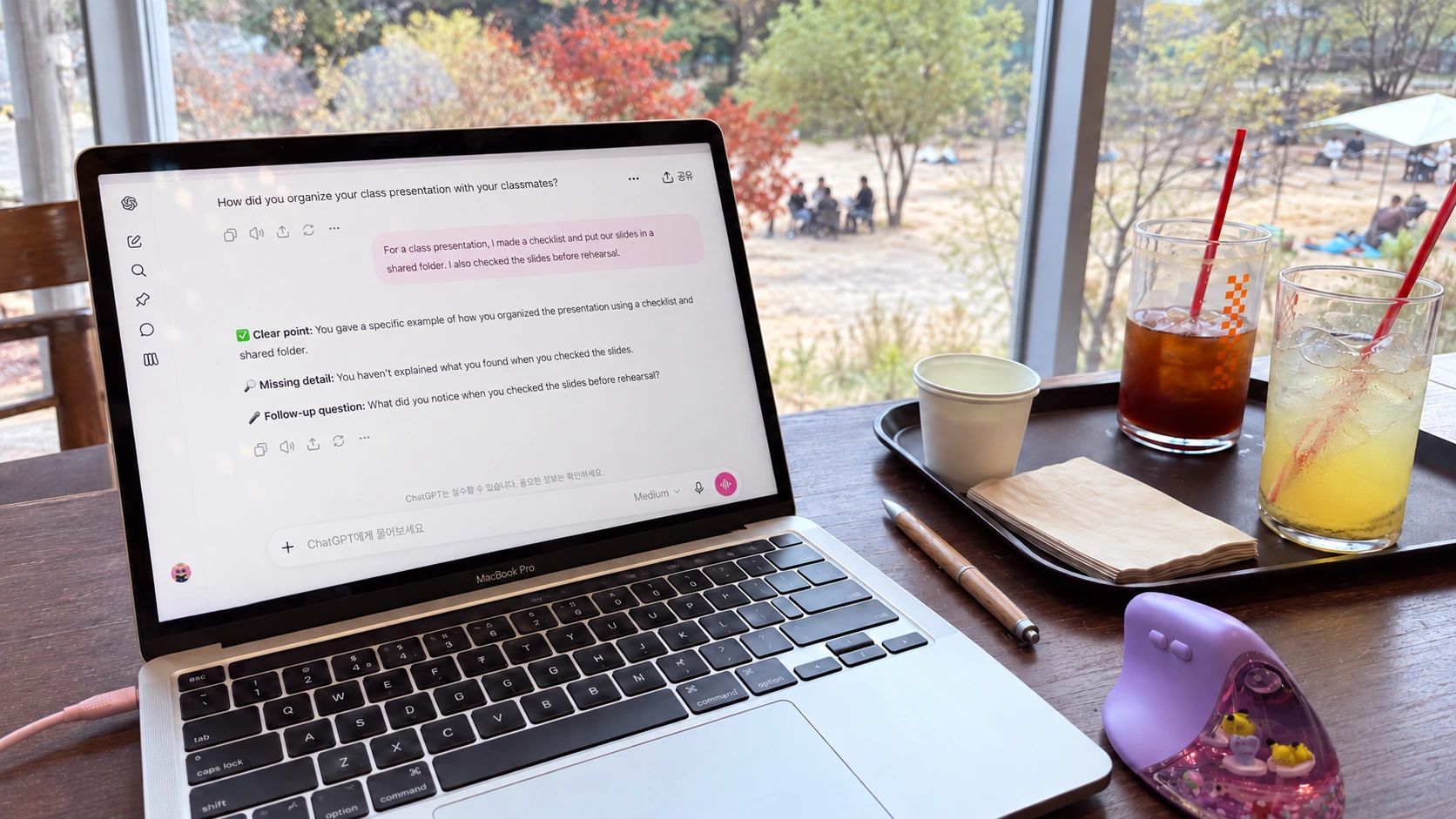
To practice a job interview with AI, ask for one question, answer it yourself, and use the feedback to see whether it needs a more specific detail. You can start in a text chat with a job posting and a few notes about something you have actually done. Start with one line from the job posting and one experience you can describe.
The example below uses fictional application materials in a real ChatGPT conversation. A short answer about a class presentation became more specific once it explained what the applicant noticed in the slides. No real applicant or hiring outcome was involved.
Bring a short posting and one experience
Copy the responsibilities you want to practice for, then write a few plain notes about a relevant project. Keep your own actions separate from what the group did. Remove contact details and confidential information before pasting anything into the chat.
Use your own job posting and experience notes in the prompts below. Replace each item in square brackets with the information it names, and remove the brackets before sending.
The screenshots use these fictional materials so you can see what changed in the answer:
| Material shown in the screenshots | Fictional details |
|---|---|
| Role | Entry-level content coordinator: organize shared files, coordinate small projects, and write clear instructions. |
| Experience | Prepared a class presentation with two classmates; created a checklist; put slides in a shared folder; noticed two duplicate slides before rehearsal; asked the group to merge them. |
| Unrecorded results | No grade, time saving, or audience feedback was supplied. |
A school assignment, volunteer task, or personal project is enough for this exercise if it relates to the question. You do not need to turn it into a larger achievement before practicing.
Ask for a question, then wait to write the answer
- Open ChatGPT, sign in if needed, and start a new chat.
- Copy the whole prompt below into the message box. Fill in the four bracketed items with your job title, the skill to practice, the relevant responsibilities, and your experience notes.
- Select Send. Read the question before asking for any suggested answer.
Copy this prompt to start your session. In your experience notes, include your role, what you did, and any result you can confirm.
Help me practice interviewing for [job title] in English, one question at a time.

Use my job description and experience notes below. Start with one short
question about [skill or type of experience to practice]. Do not add a second
part. Wait for my answer.

After I answer, tell me one part that is clear. If an important detail is
missing, name it and ask one factual follow-up question. If no important
detail is missing, say so and stop instead of inventing a gap or question.
Keep feedback under 100 words.
Do not write an answer for me until I ask.

Use only facts I supply. Do not invent duties, results, numbers, or skills.
If I say “revise,” help me rewrite my answer using confirmed details,
then stop so I can practice it aloud.

JOB DESCRIPTION:
[relevant responsibilities from your job posting]

EXPERIENCE NOTES:
[your factual experience notes]
For the skill field, name one thing you want to practice explaining, such as organizing a project or finding an error. Keep the first round focused on one experience.
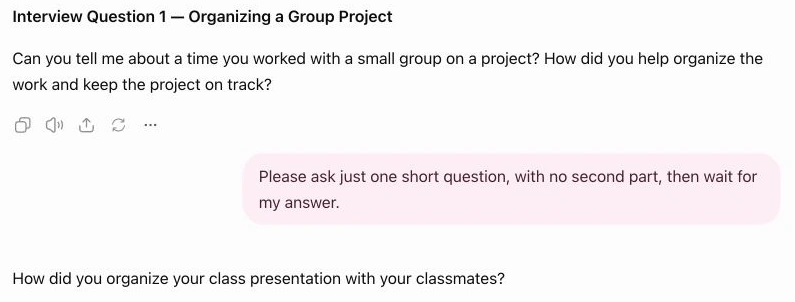
If ChatGPT asks a question with several parts, send this in the same chat:
Please ask just one short question, with no second part, then wait for my answer.In the recorded demonstration, that follow-up changed a two-part question to:
How did you organize your class presentation with your classmates?
Give a rough answer before asking for a rewrite
Answer the question in the same chat before asking for a rewrite. You can use this block:
My answer to your question:
[your answer to the current interview question]
Write it in your own words using your experience notes. The first answer in the recorded demonstration was:
For a class presentation, I made a checklist and put our slides in a shared folder. I also checked the slides before rehearsal.
That tells the interviewer what the applicant did, but “checked the slides” leaves out what the check involved. ChatGPT’s follow-up asked:
What did you notice when you checked the slides before rehearsal?
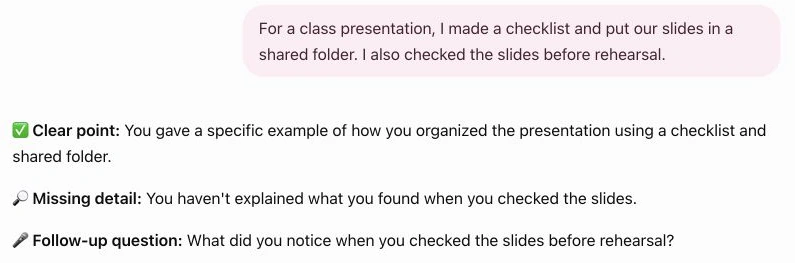
For your answer, look for the same kind of gap: a broad phrase such as “helped,” “organized,” or “checked” that could describe many different activities. Add the action you can explain from memory or records. If you do not remember the detail, say so rather than choosing a plausible one from an AI suggestion.
Add the fact, then ask for two sentences
When you have confirmed the missing detail, copy this into the same chat. Fill in the detail you want to add and any result you can verify. If no result is recorded, write “No confirmed result” in that field. ChatGPT can use your previous answer from the conversation.
Revise my latest interview answer into two natural sentences using my
experience notes and the confirmed facts below. Keep my responsibility
at the level I described.
Do not add a new duty, number, result, or skill. If a result is not confirmed,
leave it out. Then stop so I can practice the answer aloud.

DETAIL TO ADD:
[the specific action or detail you can confirm]

CONFIRMED RESULT:
[the result you can verify, or No confirmed result]
In the recorded demonstration, the added detail was two duplicate slides and a request for the group to merge them. The message also said there was no recorded grade or other outcome and asked for two sentences. ChatGPT returned:
For a class presentation with two classmates, I created a checklist and organized our slides in a shared folder. Before rehearsal, I noticed two duplicate slides and asked the group to merge them.
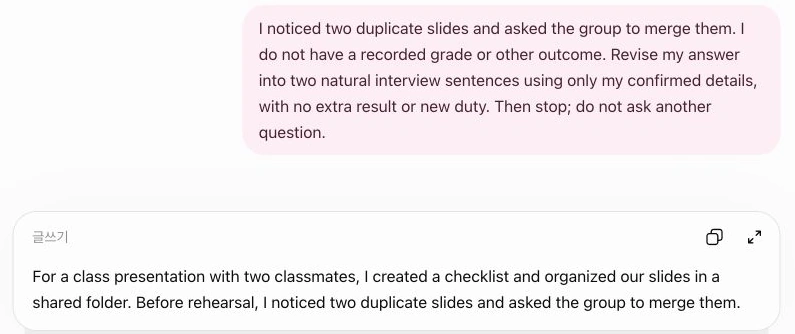
The second sentence now explains what “checked” meant. It says the applicant asked the group to merge the slides; it does not claim the slides were merged or that the presentation earned a better grade. Keep that distinction when you edit your own answer.
Practice your job interview answer in your own words
Before using a revision, compare its actions, numbers, and results with your notes. If something was added, ask:
Remove this unsupported detail from my answer:
[the exact phrase or claim that is not supported by your notes]

Revise only the affected sentence using the facts I supplied. Do not add
another activity or result to replace it.
Then read the checked answer aloud once without looking at the chat. Notice where you lose the thread or use wording you would not normally say. If the wording feels awkward, use this in the same chat:
Rewrite my latest interview answer in simpler, more natural spoken English.
Keep the same facts, numbers, and level of responsibility. Do not add a new
activity or outcome. Give me one version, then stop so I can practice it aloud.
This spoken practice is a next step to try; it was not tested in the text demonstration.
Save the question, the answer you can comfortably explain, and any detail you still need to confirm. When you are ready for another round, copy this into the same chat:
Ask the next interview question using my job description and experience notes.
Ask only one short question, with no second part, then wait for my answer.
Finish one round before collecting more questions
AI interview practice can give you a question and focused feedback on your answer. In this demonstration, the useful change was small: a vague slide check became a specific observation and action. That is a result you can inspect in the text, rather than a prediction about how an employer will respond.
Start with one experience, answer one question yourself, and check one revision against your notes. Keep the version you can explain naturally before moving on to another question.
If you’re still choosing an example, match the job description to your experience first. Bring one match you can support with a specific action.
Source
- OpenAI Help: ChatGPT capabilities overview — background on text conversations and rewriting. The interview-specific observations above come from the captured fictional demonstration.