
Here is how to verify ChatGPT sources before you trust an answer.
A citation makes a ChatGPT answer look finished faster than it makes it trustworthy.
That is the trap I kept running into while working on VEYREM. You get a clean paragraph, a little source marker at the end, and your brain wants to move on. The answer looks researched. The awkward part starts when you actually open the page.
Sometimes the source supports the sentence exactly. Sometimes it supports a smaller version. Sometimes it is current but not authoritative. And sometimes the citation is real while the sentence attached to it is still too confident.
OpenAI’s own Search help page says search results and citations can be incomplete, outdated, or incorrect, and recommends opening the source to check whether it actually supports the answer. OpenAI Help: Searching the web with ChatGPT
So I stopped asking, “Does this answer look well researched?”
I ask one narrower question:
Does this page earn the exact sentence I am about to publish?
That question has been much more useful.
Table of Contents
The citation is where I start checking, not where I stop
To verify ChatGPT sources, I start by asking whether the cited page supports the sentence next to it. A real source can still be the wrong evidence for the sentence sitting next to it. The claim may be broader than the page. The page may be old. The source may be relevant but not authoritative. Or ChatGPT may have quietly dropped the condition that made the original statement accurate.
OpenAI’s own guidance says to treat ChatGPT as a first draft rather than a final source and to verify important quotes, data, technical information, and external references directly. OpenAI Help: Does ChatGPT tell the truth?
That is the part I care about: not whether a citation exists, but what I am still allowed to say after I open it.
How to Verify ChatGPT Sources: My Four-Part Check
1. I look for the sentence, not a page that feels close enough
I start with the exact claim I might publish and look for the part of the page that supports it. A related headline is not enough.
This matters most with dates, feature names, availability, pricing, quotes, and numbers. “Available in ChatGPT” and “available to every ChatGPT user” are different sentences. If the page only earns the first one, I publish the first one.
2. I ask whether I would have picked this source without ChatGPT
Relevant is not the same as authoritative.
For pricing, plan limits, product rules, or policy, I want the company’s current help page, documentation, pricing page, or release notes. A third-party article may explain the feature better. I still would not use it as the final authority on the company’s own limits.
If I would not have trusted the source before ChatGPT handed it to me, the citation does not magically upgrade it.
3. If the claim can change, I treat the date as part of the claim
Old information can be quoted perfectly and still be wrong today.
AI products are especially annoying here. Plans change, limits move, names get replaced, and features roll out unevenly. OpenAI specifically recommends checking when a cited source was published or updated. OpenAI Help: Searching the web with ChatGPT
If the claim can change, the date is part of the claim.
A launch post is useful history. It is not enough by itself to tell me what a reader gets right now.
4. I let the source make the sentence smaller
I do not open a source to prove ChatGPT right. I open it to see how much of the sentence survives.
Sometimes I have to add a plan or workspace boundary. Sometimes I separate an old announcement from the current setup. Sometimes the source tells me what a feature does, but says nothing about whether it works well for everyone.
The sentence usually gets less impressive after this step. Good. I would rather publish a smaller sentence I can defend than a cleaner one the source never actually made.
One page, two very different sentences
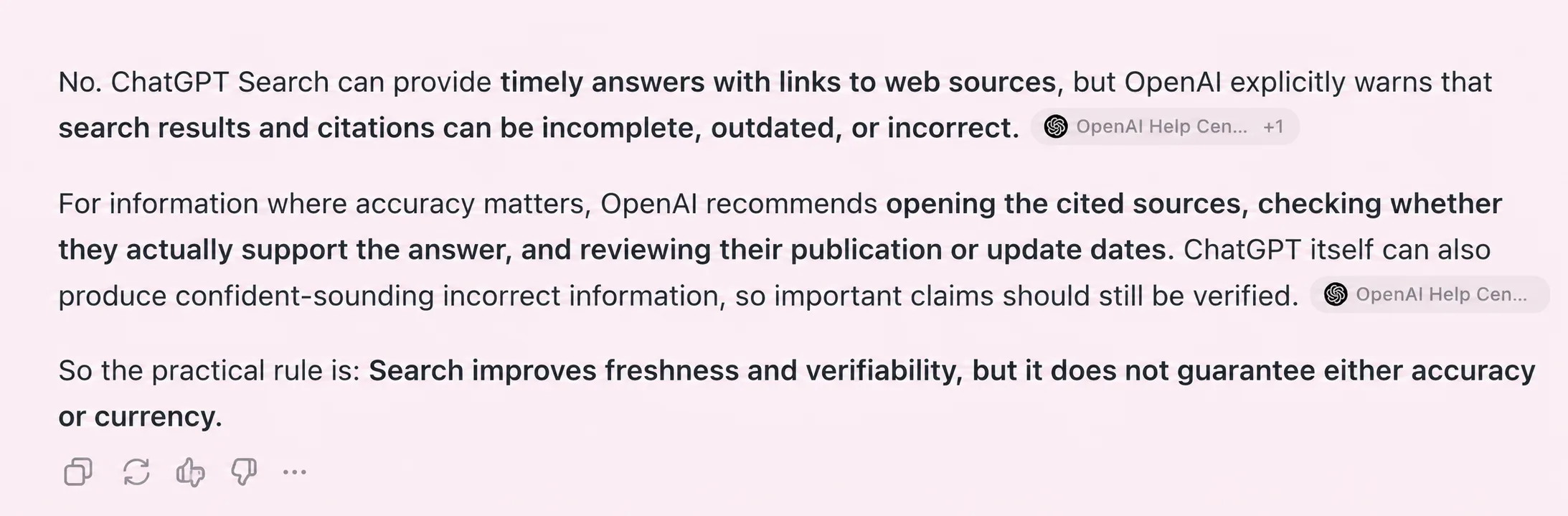
The current OpenAI Search help page is a good example of why I verify ChatGPT sources sentence by sentence.
A sourced answer can easily leave me with a sentence that sounds safer than the source actually is. For example:
“ChatGPT Search provides reliable, current answers with sources.”
I would not publish that line. It sounds reasonable, but the page does not support that level of confidence.
What the page says is narrower: Search can bring in current web information with citations, while the results and citations themselves can still be incomplete, outdated, or incorrect. OpenAI Help: Searching the web with ChatGPT
So I would shrink the sentence to this:
“ChatGPT Search can surface current web information with citations, but OpenAI recommends opening the cited page and checking that it supports the answer when accuracy matters.”
Same source. Smaller claim. That is usually the edit I am looking for.
The answers that make me stop and open every source
I can usually verify ChatGPT sources faster when the source is official, current, low-stakes, and the wording lines up cleanly.
I slow down for prices, plan limits, deadlines, availability, statistics, quotes, technical specs, higher-stakes advice, or conclusions stitched together from several pages.
And I get suspicious when a messy question comes back looking too tidy.
Sometimes ChatGPT compressed the mess. Sometimes it compressed the condition that made the answer true.
The part I still want to decide myself
A bad citation does not mean I throw away the whole answer. I can narrow the sentence, replace the source, update the date, or cut the claim.
What I do not hand back to ChatGPT is the last judgment call:
How much does this page actually let me say?
That is why I still verify ChatGPT sources myself. ChatGPT is very good at getting me close to the evidence, but deciding where the evidence stops is still my job.