
I checked a ChatGPT study answer against my economics notes. The final answer was right, but the explanation left out the calculation.
The problem asked which country could make one product while giving up less of another. Economists call that comparative advantage. ChatGPT chose Country X. My calculation supported that choice: Country X gave up 0.8 units of the other product, compared with Country Y's 1.6. I wanted that step in the explanation before studying from it.
This check focuses on the comparative-advantage part of Problem 2.
Try the two divisions first: calculate 1 ÷ 1.25 for Country X and 2 ÷ 1.25 for Country Y. The results—0.8 and 1.6—are units of Good Y given up per unit of Good X. Compare them with the calculation table below before trying the optional Excel reproduction.
In this article
What I asked ChatGPT to explain
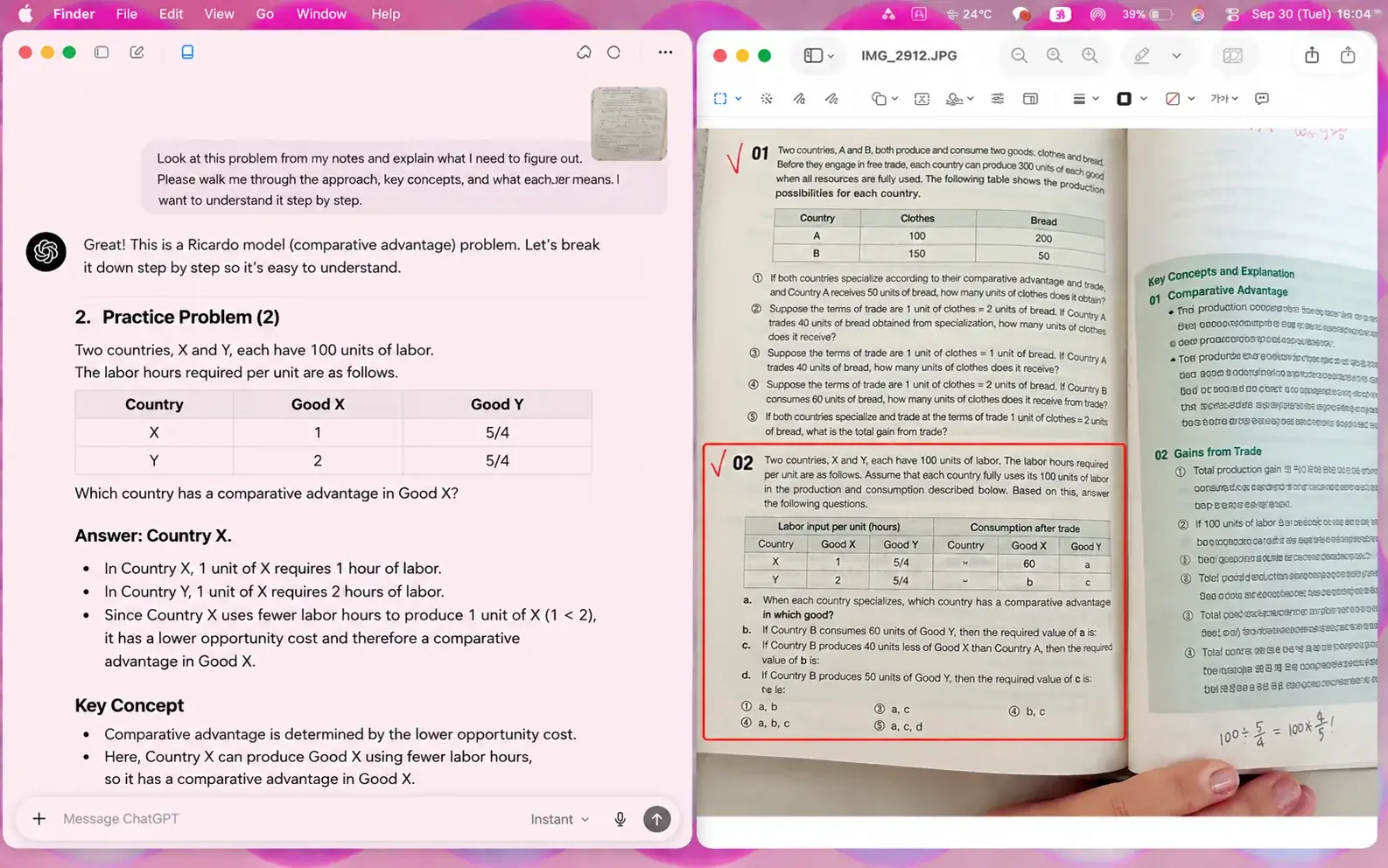
My request was to look at a problem from my notes and explain the approach, the key concepts, and what the terms meant. The answer checked here appears beside the boxed Problem 2 in the image below.
Checking a ChatGPT Study Answer Against the Source
Problem 2 calls the products Good X and Good Y. Each country has 100 units of labor available. Its table says how much labor it takes to make one unit of each product: Country X needs 1 for Good X and 5/4 for Good Y; Country Y needs 2 for Good X and 5/4 for Good Y. A smaller number here means less labor needed, not less of the product made.
The displayed answer names Country X. That conclusion is correct, but the explanation moves from “fewer labor hours” to “lower opportunity cost” without showing the calculation. Here, opportunity cost means how much Good Y the country gives up to make one unit of Good X. I worked that out for both countries:
| Country | Calculation from the source inputs | Good Y given up for one unit of Good X |
|---|---|---|
| Country X | 1 ÷ (5/4) = 4/5 | 0.8 units of Good Y |
| Country Y | 2 ÷ (5/4) = 8/5 | 1.6 units of Good Y |
For example, Country X uses one unit of labor to make one unit of Good X. That same labor could make 1 ÷ 1.25 = 0.8 units of Good Y. Country Y gives up 1.6 units of Good Y instead. Since 0.8 is less than 1.6, Country X has the comparative advantage in Good X.
I worked through these calculations to check the answer. They weren't included in the ChatGPT reply shown here. Fewer labor hours alone tell me which country produces a good more efficiently. Comparative advantage requires comparing what each country gives up. In this exercise, both countries need the same labor input for Good Y, so the shorter explanation reaches the right country. I would still want to see the opportunity-cost calculation before using this explanation to solve another problem.
Problem 2 is boxed so the AI explanation can be checked against the exact source exercise. This is an English-localized editorial reconstruction, not an original screenshot.
The two divisions give me a method to check on the next problem.
I tried the calculation with a number missing
The published Problem 2 inputs were entered into a separate worksheet and recalculated in desktop Excel for Windows (version 16.0, build 20430). Country X returned 0.8 and Country Y returned 1.6 units of Good Y per unit of Good X. Exact fraction arithmetic independently gave 4/5 and 8/5. The calculation confirms Country X’s lower opportunity cost for this problem.
The temporary tests below changed the reproduction only. They did not change the source problem or rerun the original ChatGPT conversation. The worksheet requires two numeric, positive labor coefficients for each country before dividing labor per Good X by labor per Good Y.
| Temporary input check | Expected and observed in Excel |
|---|---|
| Original inputs: X = 1 and 1.25; Y = 2 and 1.25 | 0.8 versus 1.6; Country X has the lower opportunity cost. |
| Country Y’s Good X labor changed from 2 to 1 | 0.8 versus 0.8; a tie, not a forced Country X result. |
| Country X’s Good Y labor set to 0 | Invalid input; no country is selected. A zero labor coefficient is outside this exercise’s positive-input assumption. |
| Country X’s Good Y labor cleared or replaced with text | Missing input; no country is selected. A missing number is not treated as zero. |
| All four original inputs restored, saved, and reopened | 0.8 versus 1.6, with Country X selected again. |
To reproduce the worksheet check, put the country names in A2:A3, labor per Good X in B2:B3 (1 and 2), and labor per Good Y in C2:C3 (1.25 and 1.25). Put this formula in D2 and copy it down to D3:
=IF(COUNT(B2:C2)<>2,"Missing input",IF(OR(B2<=0,C2<=0),"Invalid input",B2/C2))Compare the two numeric results only after both rows have valid inputs. Restore B2:C3 to the original four values after testing. The final saved reproduction retained those inputs and the 0.8/1.6 results. This checks the arithmetic and input handling for one published exercise; it does not establish ChatGPT’s accuracy on other questions.
What I would ask before learning from this answer
You can use the same check with a calculation question from your own course; it doesn't need to be an economics problem. Open a ChatGPT conversation and use + beside the message box to attach a clear photo or PDF page of the exercise. Keep the question, table headings, numbers, units, and any conditions visible.
Paste the suggested request below into the message box. Replace [problem number] with your exercise number and [Paste the existing answer here.] with the answer you want checked. Send it with the page attached. This is not the request shown in my session.
Check this answer against the attached study page. Focus only on [problem number].
First write out the relevant numbers, labels, and units, then wait for me to check them against the page. If anything is unreadable, ask me to clarify it.
After I confirm them, show the formula, put the numbers into it, and explain what the result means. Compare those steps with the answer below.
Tell me whether the final answer is correct and whether the reasoning is complete. Identify any missing step or claim the page does not support. Do not invent a new question or silently change the numbers.

Answer to check:
[Paste the existing answer here.]
First compare the numbers, labels, and units it lists with your page. If they match, reply:
The values and units match the page. Now show the calculation.If one is wrong, give the correct value before asking it to continue.
For Problem 2, the explanation should then show 1 ÷ (5/4) and 2 ÷ (5/4), and say why the smaller result gives Country X the comparative advantage in Good X. For your problem, compare the formula and arithmetic with your textbook's worked method or another reliable solution. A second ChatGPT answer alone isn't an independent check.
OpenAI's accuracy guidance says ChatGPT can give incorrect or misleading information confidently and recommends verifying important information against reliable sources. For this exercise, that means returning to the problem's inputs and the definition of comparative advantage. OpenStax explains the same distinction between producing efficiently and producing at a lower opportunity cost.
For longer study material, the PDF-summary check shows how to compare a summary with its source page.
Once you have checked the explanation, the Study Mode guide shows how to practice by answering one question at a time.
The check I would keep
For this one problem, ChatGPT reached the right country but left out the opportunity-cost calculation. I would keep the answer and add the missing calculation before studying from it. One checked answer does not establish how reliable ChatGPT is across other problems.
That gives me a specific stopping point: the inputs match the page, the arithmetic works, and the explanation shows why the result answers the question. If one of those is missing, I would ask for that part rather than another longer explanation.
Evidence and check dates
- Tool: ChatGPT for one historical study explanation; desktop Excel 16.0, build 20430 for arithmetic reproduction.
- Model: Original ChatGPT model not recorded.
- Dates: Original study date not recorded. Arithmetic reproduction and source recheck: October 23, 2026.
- Input: Problem 2: labor per Good X/Good Y is 1/(5/4) for Country X and 2/(5/4) for Country Y.
- What was checked: Direct calculation: 0.8 versus 1.6, checked with fractions and Excel. Missing, zero, and tie cases were checked separately; original inputs restored.
- Not checked: No new study conversation, question-generation test, or general ChatGPT accuracy score.
Source status: Rechecked October 23, 2026: OpenStax — Absolute and Comparative Advantage. The 0.8/1.6 values come from this exercise’s supplied inputs, not an OpenStax example. The older OpenAI accuracy reference was not reverified on this date.